
Standardising skills is a typical requirement of a globalised world, and the question of language certifications is just one aspect of it.
People today travel by choice or out of professional necessity, or else work in their own country while dealing constantly with foreign markets or foreign business partners: they need their professional skills to count wherever they work and whoever they work with.
The value of a qualification, and the equivalence between qualifications and experience obtained at different schools or even in different countries, are therefore perennially topical issues, and the answers differ from one field to the next.
In the field of languages, though, the question has always been felt more keenly. That is why the leading cultural institutions in the various countries have developed a range of internationally recognised certifications, obtained by passing exams set at standardised levels and often geared to specific sectors.
Every country has organised things differently, granting legal validity to certifications issued sometimes by private and sometimes by public bodies: they range from TOEFL for English (originally created as an admission test for foreign students at American universities and run by the non-profit organisation ETS – Educational Training Service) through to DELF for French (run directly by the French education ministry).
In some countries, moreover, several certification systems run side by side under different bodies, although there is almost always one that has established itself more firmly than the rest.
These certifications often open the door to universities, training institutions or job competitions. Indeed, people who follow a course of study aimed at obtaining one of these qualifications often do so because they are after a particular position (at work or in education) that requires it.
The details of the main certifications for the languages taught at our school will be the subject of forthcoming articles, so as to give you a complete overview, language by language, of the language certifications you may be asked for in your line of work and of the bodies that issue them.
On that note, remember that at European School you can attend courses designed specifically to prepare for every language certification exam.
The Common European Framework of Reference for Languages
From the 1990s onwards, the European Union has organised the assessment of language skills on a standardised basis – so as to allow an immediate, objective comparison of language skills even across different languages.
This is the Common European Framework of Reference for Languages (CEFR), known in Italian as the Quadro comune europeo di riferimento per la conoscenza delle lingue (QCER).
In all, the six levels provided for, grouped into three bands, are as follows:
A – Basic user:
A1 – Breakthrough
A2 – Waystage
B – Independent user:
B1 – Threshold
B2 – Vantage
C – Proficient user:
C1 – Effective operational proficiency
C2 – Mastery of the language in complex situations
The CEFR and language certifications
Many of the finer points of the CEFR are far from settled, and research, conferences and meetings between scholars and institutions continue, all working towards better standardisation in the assessment of skills.
In practice, however, when you move on from simple self-assessment to certifying your skills against the levels set out in the CEFR, you go back to the national institutes and systems that run language certifications within each country.
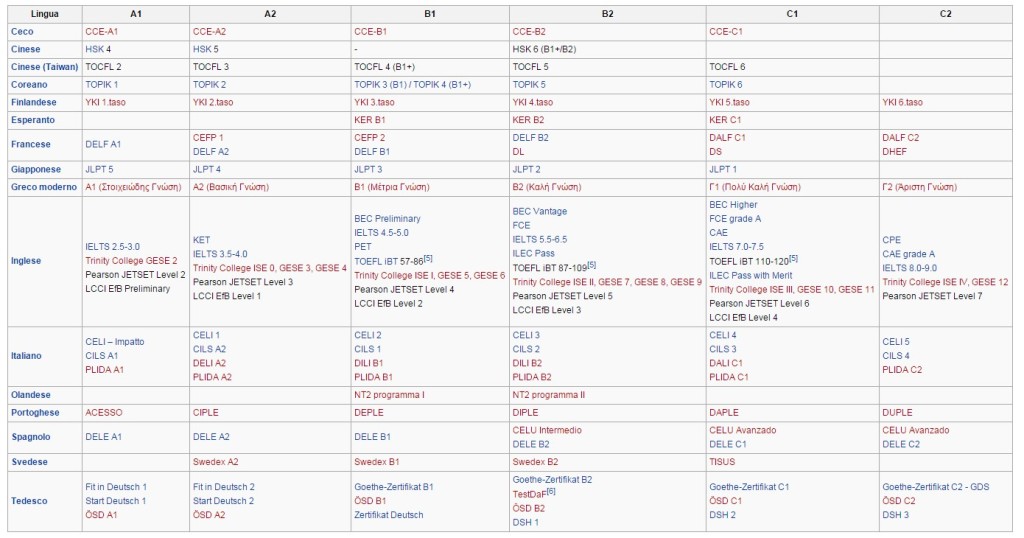
So, for example, to certify an A2 level of French, I will need a DELF A2 certificate issued by the Ministère de l’Éducation nationale française, or a CEFP1 certificate issued by the Alliance Française, the largest organisation for the teaching of French.
For the sake of clarity, below is a table taken from Wikipedia setting out the conversions between the CEFR system and the official certifications issued by the national institutions for the European languages we teach, and for Japanese.
In the meantime, we look forward to seeing you in the coming articles, where we will look in detail at the recognised certifications for each of the languages taught at our school.