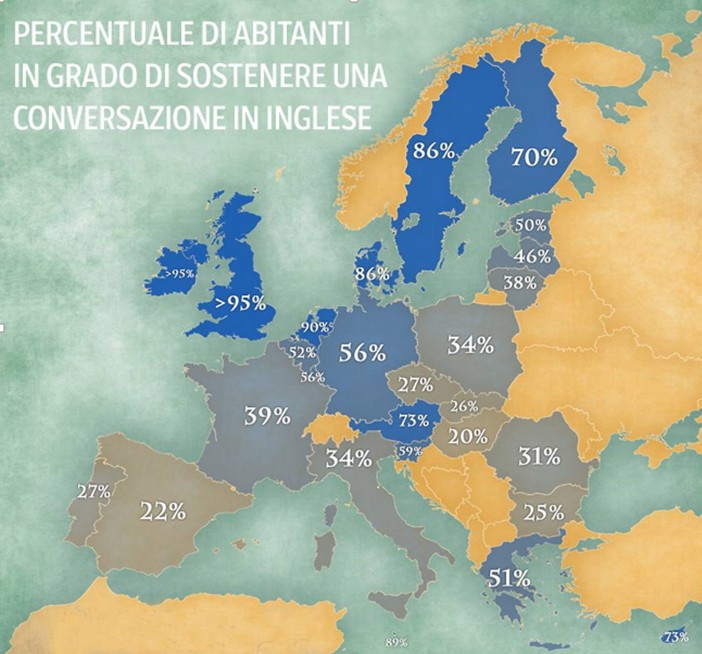

For an Italian who wants to go on working in Italy and to get better opportunities, the foreign language you absolutely need to know for work is obviously English. But by now an intermediate, or better still an intermediate-to-upper-intermediate, level of English is no longer an extra on your CV, but a standard that should always be there.
Taking it for granted, then, that English is well known, anyone who wants an edge in the tough competition of the job market looks to add a third language.
Some are undoubtedly more in demand than others. We will try, then, to give you a general overview, though with one necessary caveat: the most useful language to learn often depends on the sector you work in and on the kind of contacts your own area of residence has developed. Take German, for example: much sought after in industry and commerce, but not much use in tourism, unless you live along the Adriatic coast, where it is practically compulsory because of the high numbers of tourists arriving from Germany and Austria.
That is why all the articles you will find on the subject give conflicting advice. Some name French as the most interesting third language, others name German. Spanish is almost always mentioned in second place, immediately followed by Chinese and then Russian or Arabic. Sometimes Portuguese is also mentioned among the most interesting languages, while the popularity of Japanese is in clear decline.
In this article, then, we will not give you a rigid ranking; instead we will simply get you thinking about the languages listed above, why they can be useful and in what contexts. After that, we recommend you check carefully what is asked for in your own sector of work and area of residence.
If in doubt, listen also to your own interests and passions: learning a language takes real commitment, and a genuine interest in the subject matters for keeping you going along the way.
French matters because…
French is spoken by a considerable number of native speakers, a number that is steadily growing too, once you count France, Canada and a number of African states now going through strong demographic growth. Above all, these are all countries with close trade ties to Italy and are relatively nearby (Canada aside). And if a company needs to trade with France, having someone who speaks French comes in handy, because it is not a given that you will find a counterpart on the other side of the Alps who speaks good English.
French is also one of the languages most used in international relations, which makes it a good choice for anyone who wants to work in diplomacy or inside international organisations.
German matters because…
Because Germany is Italy’s number one trading partner, which is why so many companies look for staff who also speak German. What is more, it is not a very easy language to learn, so you will certainly have less competition than someone offering Spanish or French as their third language!
Spanish matters because…
Spanish is both one of the three most spoken languages in the world and one of the most studied, and it will let you communicate with a huge number of people. Above all, it is spoken in many emerging Latin American countries that Italian companies are increasingly interested in. And then, for an Italian it is relatively quick to learn, even quicker than French (thanks above all to its simple pronunciation) – so why not make the most of that?
Chinese matters because…
Because it is the language of the world’s second-largest trading power and the single most widely spoken language of all. It is a language on the rise, but be warned: far more than with European languages, learning Chinese means immersing yourself in a very different culture, including in its behaviours and values. It is decidedly demanding, but it can bring huge rewards, both professionally and personally.
Russian matters because…
Because Russia is a keen buyer of Made in Italy goods, especially when it comes to fashion and luxury products, so learning Russian is a sound investment, particularly if you work in those sectors or in high-end tourism. Even if Russia has, for now, cut back on imports because of political tensions, it is reasonable to expect trade to pick up again within a relatively short time.
Arabic matters because…
Arab countries, too, are certainly fond of our Made in Italy products and import them in large quantities. However, those who recommend studying Arabic do so above all in view of the growing demand for interpreters and social-sector workers who speak Arabic here in Italy. This reflects the increasingly settled presence of immigrants and the need to get integration processes moving for these communities.
Portuguese matters because…
The reason some recommend studying Portuguese is the growth of Brazil, the most important country in Latin America and the one enjoying the most impressive growth.
It is uneven growth, sometimes rapid and sometimes seeming to stall, but one that constantly needs to be underpinned by infrastructure and machinery for new production activities: a process that Italian companies have noticed very well indeed, so much so that some have staked their expansion plans precisely on this vast new market.
Did you enjoy this article? In our next one, before we say goodbye for the summer, we will look at some curiosities and some figures about the world’s most widely spoken languages. See you soon!