In February European School’s #conversationweek kicks off. One hour of conversation with native-speaker teachers, completely free, with a certificate of attendance stating your language level.
Want to know why it’s worth taking part?
In everyday life you’ve probably come across friends and acquaintances who have a kind of asymmetric knowledge of foreign languages, English above all: they understand almost everything they read, but can barely recognise a sentence in a song – they lack spoken or conversational skills, the “conversation skills”.
The profiles vary widely: the most extreme example (though far more common than you’d think) of this category is a professional used to chewing through technical manuals strictly in English, with the basic grammar and syntax skills needed to understand them, but who never finds themselves having to speak or to listen – that is, they never connect the sounds to words they already know in written form.
At a milder level, instead, we find many language learners at the most varied levels. Those who pick up the written form thanks to their intelligence and study effort, but who struggle to decode the message when faced with the sounds of the living language.
If you’re among them, we want to reassure you: it’s perfectly normal.
The ear needs training; our mind needs training. The kind needed to listen to and become familiar with the sounds of a foreign language, as well as the kind needed to speak by instantly translating an abstract thought into words that aren’t those of our native tongue.
The importance of the spoken language
It’s no coincidence, then, that all language tests give a separate assessment of written and spoken skills, nor that teaching devotes specific attention to conversation in a foreign language.
Conversation lessons often become more frequent as the student’s level improves.
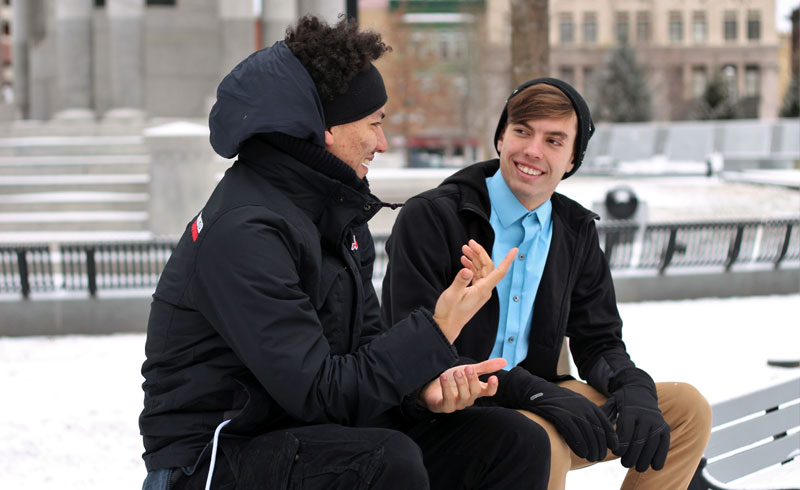
Conversation skills, moreover, aren’t only essential for using a foreign language at work or while travelling: they are also the key to one of the most beautiful experiences a person can have, that of connecting with, getting to know and talking with someone from a different culture than our own.
European School’s new #conversationweek
The teaching method proposed by European School has always aimed to give full command of the language, including spoken expression skills.
That’s why we’ve launched a new initiative, completely free for participants: Conversation Week.
On the dates and at the times indicated, strictly native-speaker or bilingual teachers will hold a free hour of conversation in English, French, German and Spanish, starting from a current-affairs topic. At the end of the hour, every participant will receive, free of charge, a certificate stating their language level in spoken proficiency.
Want to put yourself to the test? Find here all the information you need to take part.
We look forward to seeing you!