
Studying a foreign language is a considerable investment, one in which the “time” and “personal commitment” components are often underestimated when they ought always to come first.
With the “financial cost” variable, on the other hand, the risk is simply of working it out wrongly.
Lastly, choosing which language to study is also crucial if the investment is to yield the returns you are hoping for.
In this article we want to show you the study of a foreign language as an investment from every one of the angles listed above — the way it should be looked at whenever you seriously set out to learn a new language or to improve one you have already learned.
Variable 1: learning a language takes time
The time our mind needs to take a concept in is far longer than the time it takes to “understand” it. Our teachers can explain the present-tense verb conjugations in German to you in under an hour, and that hour will certainly be enough for you to grasp them logically.
But certainly not to memorise them, absorb them properly and use them. The “time” variable in language courses is fundamental. Even a course designed as an intensive one has to leave our mind room to take the concepts in properly and organise them into a clear, coherent structure that lets us find our way without difficulty through the workings of a grammar that is foreign to us.
The time needed varies, of course, according to the aims of the teaching and your starting level (those who already have good foundations take less time to absorb new knowledge).
That is why it is always worth working out your study plan together with your teacher, so that the study times you are given are the ones realistically needed to reach your goal.
Variable 2: personal commitment has to be constant
Paying attention during the lesson matters, of course. But it will not get you far if you are not prepared to focus your energy on the goal of “learning English / German / Arabic” outside lesson hours as well.
You need concentration during lessons. You need to be diligent studying at home. But to get the results you are hoping for, you also need to stay focused on the goal while having a coffee at the bar (perhaps running back over absolute superlative adjectives in your head) or watching a film (perhaps seeking it out in the original language, subtitles and all).
If you bring that kind of mental attention to it, the chances are your results will be excellent. If not, they are likely to fall short of expectations and you will fall back on the “I have no gift for it / I just can’t do it” excuse.
Variable 3: what it costs to learn a foreign language
A language course usually costs X Euro an hour. But what does it cost to learn a foreign language?
Let us think in mathematical terms. Assuming your goal is to reach level Y in the language you have chosen, the cost you will face is X Euro an hour multiplied by the number of lesson hours needed.
“Elementary, my dear Watson.”
So there are two routes I can take to reduce my financial investment:
- Choose a school or a teacher with a low hourly rate. That is an illusion rather than a solution, because with a less able teacher I will probably have to sit through a longer course before reaching the language level I need.
- Better to choose a language school with excellent teachers who give me the kind of preparation I am after in the time it takes, and no longer.
The best way to reduce the cost of learning is to pair a good teacher with the advice set out in the paragraphs above: full attention during the lesson, daily study to memorise and absorb the lessons, commitment and focus on the goal.
A good teacher lets you get the very most out of the whole process, because they make the subject clear and interesting and pass on a method of study before they pass on any points of language.
Remember, then, that choosing a language school on hourly rate alone is, in practical terms, a poor investment, because it takes no account of the total “cost of learning”.
Just as it is a poor investment to enrol at an excellent school and then not put in the work to get the right results.
Variable 4: choosing which language to study
English is indispensable for every company and every entrepreneur wanting to thrive abroad. Chinese is the most widely spoken language in the world. Job adverts mentioning Portuguese are multiplying, driven by growing trade with Brazil. French is enjoying a second life as an international language, while Russian looks indispensable for anyone working in fashion.
In truth, which language might be a good card to play in the world of work (to find a new job, to make your position secure, to build a career) depends on your professional profile, on the kind of sector you work in, and finally on a set of extra factors that can be largely a matter of chance (such as a company about to open a new office in The Hague looking for someone who speaks, say, Flemish).
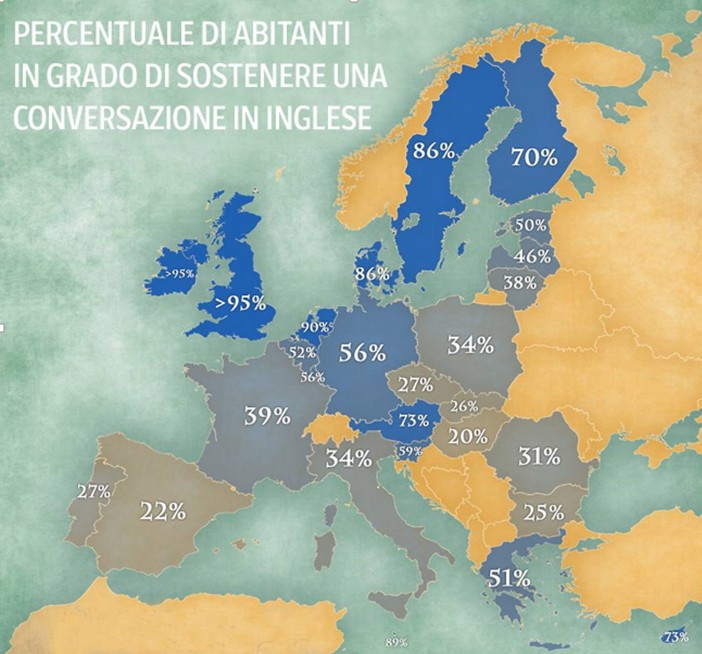
The first language to study is always English, obviously — being by now the lingua franca of trade as well as of technology, academia and scientific research. At least an intermediate level of English is a minimum requirement on any CV, no longer a point in your favour.
Choosing the language that will instead give your career an edge is far easier the more clearly defined your situation is.
If you already work inside a company and want to acquire new skills, you probably already know what you need. The same goes if you are not currently working but already have a CV pointing you towards a particular sector.
Even for those looking for a first job, though, our advice is to choose the language to learn on the basis of what is asked for in the sector or the role you are aiming at.
Only then will our investment of time, commitment and money really bring the greatest possible return.